
When you’re planning an RV trip and want to stay comfortable in hot summer weather, you’ll need a reliable way to power your RV AC. How many watts an RV AC uses depends largely on its BTU cooling output:
-
~10,000 BTU units: typically ~700–1,100 watts while running
-
~13,500 BTU units: typically ~1,200–1,800 watts while running
-
~15,000 BTU units: typically ~1,400–2,000 watts while running
-
Portable RV ACs: often ~700–1,500 watts running
One of the best off-grid options is a “solar generator” setup—a portable power station (battery + inverter) paired with Sungold Solar panels. This combo is quiet, clean, and easy to stow in a camper or motorhome, letting you keep the cabin cool away from shore power.
Why wattage varies (and how to estimate yours)
Watts = Volts × Amps. On North American shore power, assume 120 V. Multiply your unit’s running amps × 120 to estimate running watts. Startup is higher for a few seconds (compressor inrush). Draw also changes with BTU size, efficiency, ducting, ambient heat/altitude, and whether you use a soft-start.
Typical RV AC wattage ranges
| RV AC Size (BTU) | Running Watts* | Starting/Surge (no soft-start) | With Soft-Start (typical) |
|---|---|---|---|
| 8,000–10,000 | 700–1,100 | 1,500–2,500 | 1,000–1,600 |
| 11,000–12,000 | 1,000–1,400 | 2,000–3,000 | 1,200–2,000 |
| 13,500 | 1,200–1,800 | 2,500–4,000 | 1,600–2,500 |
| 15,000 | 1,400–2,000 | 3,000–4,500 | 1,800–3,000 |
Generator & inverter sizing
-
Portable generator:
-
Small/high-efficiency AC + soft-start: 2,000 W can work.
-
Typical 13.5k–15k BTU: 3,000 W inverter generator (or ~3,500 W conventional) is a practical minimum.
-
-
Inverter (battery systems):
-
Aim ≥2,000 W continuous and ≥3,000–4,000 W surge for 13.5k–15k BTU. Soft-start reduces the surge requirement.
-
Batteries: how long can I run the AC?
Example for a 13.5k BTU unit at ~1,300 W running:
-
DC power @ 90% inverter efficiency: 1,300 / 0.90 ≈ 1,444 W
-
Current on 12 V: 1,444 / 12 ≈ 120 A
-
So ~120 Ah per hour.
A 12 V 200 Ah LiFePO₄ (≈160 Ah usable @80% DoD) yields ~1.3 hours continuous AC. Higher system voltages (24/48 V) reduce current and losses but not total energy (Wh).
Can solar run an RV AC?
Yes—with sufficient array + battery. Focus on energy (kWh), not just watts.
-
If AC averages 1.3 kW, 2 hours ≈ 2.6 kWh.
-
A 1,200 W array with ~5 peak sun-hours and ~70% system efficiency makes ≈ 4.2 kWh/day.
Practical takeaway: For meaningful mid-day AC time, plan 1,000–2,000 W of solar plus 2–5 kWh of battery. A soft-start is strongly recommended.
Sungold RV Solar Recommendations (Built for North America)
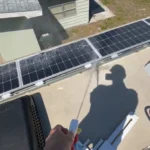
Sungold’s lightweight and flexible modules help maximize roof area, reduce heat transfer, and mitigate partial shading—ideal for RV rooftops and off-grid travel.
Core Panels
-
PA621 Lightweight Series (≈180–230 W per panel)
Anti-shade stringing, low heat transfer backing, light weight for flat roofs. -
PA219 Flexible Series (≈100–160 W per panel)
Curve-friendly, ultra-light for vans and irregular/arched roofs. -
HI-POWER Portable Folding Panels (200/300/400 W)
Angle-adjustable, quick deploy, perfect with shade or when parked.
Quick System Sizing (≈5 PSH, ~70% overall efficiency; conservative)
| Package | Example Array | Daily Energy* | 13.5k BTU AC Runtime** | Best For |
|---|---|---|---|---|
| Starter | 400 W (2×200 W roof or portable) | ~1.4 kWh | ~1.1 h | Short mid-day cooling + core loads |
| Plus | 800 W (4×200 W or roof+portable mix) | ~2.8 kWh | ~2.2 h | Summer mid-day cooling + all-day basics |
| Pro | 1,200 W (6×200 W PA621/PA219) | ~4.2 kWh | ~3.2 h | Longer comfort windows; couples |
| Max | 1,600 W (8×200 W) | ~5.6 kWh | ~4.3 h | Hot climates; family trips |
Three Ready-to-Go Combos
-
Balanced Travel Setup
-
PA621 4×200 W (800 W) + HI-POWER 200–400 W portable
-
Why: Stable roof charging while driving; portable boost when parked.
-
Target: ~2–3 hours mid-day AC + fridge/lights/sockets all day.
-
-
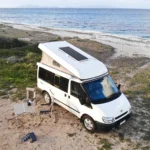
Curved-Roof Comfort Setup
-
PA219 6×180 W (~1,080 W) + 24 V 200 Ah LiFePO₄ + 2,000–3,000 W inverter
-
Why: Max area on curved vans; higher-voltage DC for steadier AC runs.
-
Target: ~3 hours AC plus comfortable night use.
-
-
Ultra-Flexible Nomad Setup
-
HI-POWER 2×200 W (400 W), expandable to 600–800 W + soft-start + 2–3 kW inverter
-
Why: Light kit, easy aiming in shade, grow as you go.
-
Target: ~1 hour AC + core loads (more with expansion).
-
Install & Wiring Tips
-
Favor well-ventilated roof areas; avoid permanent shade (racks/vents/antennas).
-
Use parallel strings to limit shade impact; design mixed series-parallel carefully with correct fusing.
-
Size wire to limit voltage drop (long runs → thicker cable).
-
Give the AC a dedicated circuit and space for the soft-start near the inverter.
Frequently asked questions
“How many watts does a RV air conditioner use?”
It depends on BTU and model, but most RV rooftop units use 1,200–2,000 running watts and may need 2,500–4,500 starting watts without a soft-start.
“How many watts does an RV AC unit use?”
A common 13.5k BTU RV AC typically draws ~1,300–1,800 W running. Starting watts can hit 2,500–4,000+ W, reduced significantly with a soft-start.
Can a 2,000 W generator run an RV AC?
Sometimes, if the AC is small/high-efficiency and you have a soft-start. For most 13.5k–15k BTU units, a 3,000 W inverter generator is the safer choice.
How many solar watts do I need to run AC?
Plan on 1,000–2,000 W of solar plus a sizeable battery (2–5 kWh) if you want hours of AC use, especially off-grid.